
As-Built Documentation for Architects & Design Firms
Skip field measuring. Start designing from accurate existing conditions captured by GRAB and delivered in the Autodesk AutoCAD, Autodesk Revit, or SketchUp formats your workflow needs.
Why architects need reliable existing conditions
Renovation and adaptive reuse projects start with understanding what actually exists. Original drawings often don't match field conditions, and manual field measuring misses critical details that affect design decisions. Wall thicknesses vary, ceiling heights change, and structural elements have been modified over time.
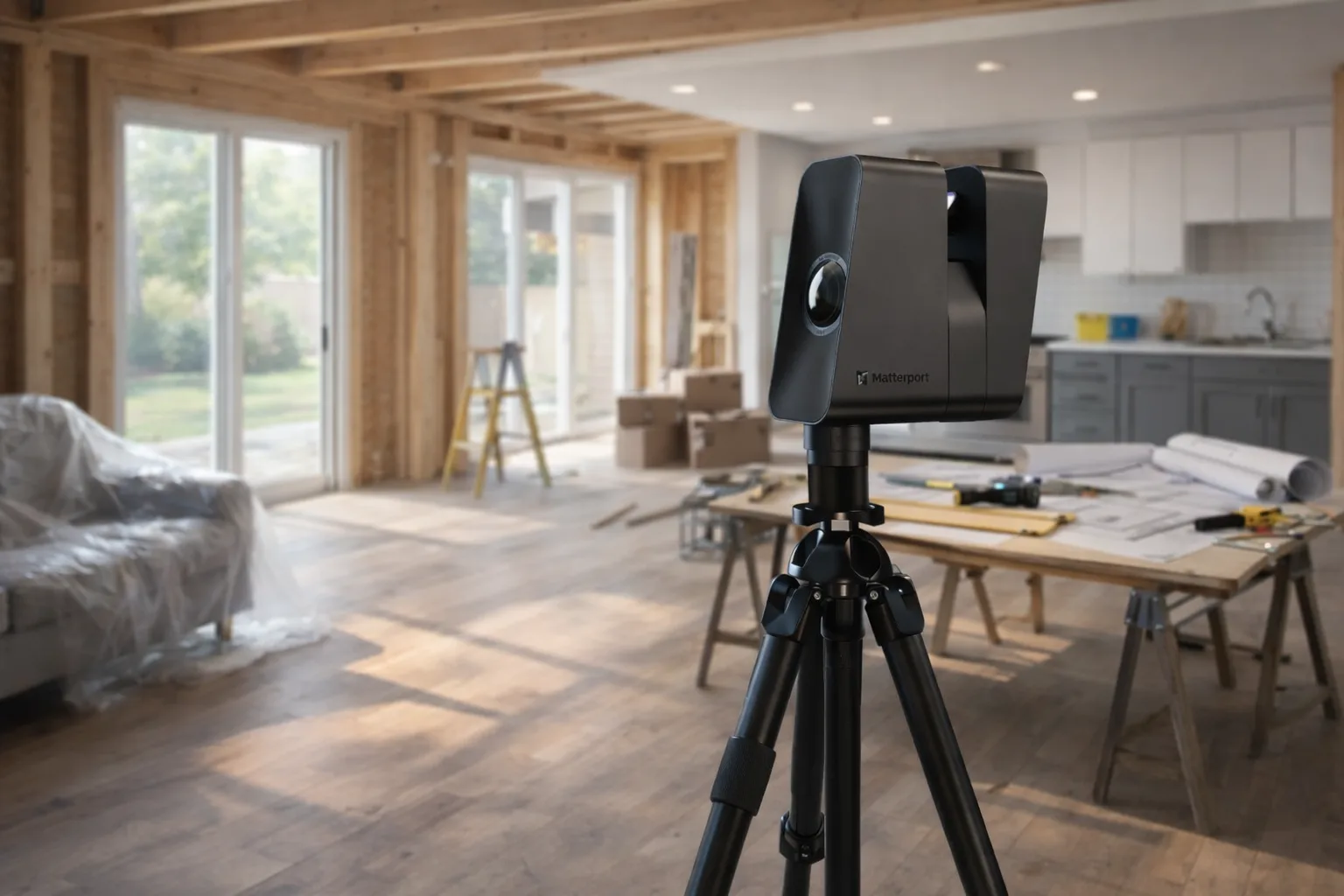
GRAB eliminates that uncertainty by capturing complete existing conditions with the Matterport Pro3 scanner. Our CAD team converts the precise scan data into professional CAD files that serve as reliable base drawings for design development — most projects deliver in 1–2 days, with larger buildings up to 5.
The result is accurate existing condition documentation that lets you start designing immediately, without return trips for field verification or surprises during construction that require design changes.
Deliverable formats
- Autodesk AutoCAD DWG files for standard CAD workflows
- Autodesk Revit RVT files for BIM integration
- SketchUp SKP models for 3D design
- Dimensioned PDF plans for reference
- Point cloud data for specialized needs
- Custom formats by request
Integration with design workflow
Our deliverables integrate directly into standard architectural workflows. CAD files import cleanly into Autodesk AutoCAD, Autodesk Revit, SketchUp, and other design software as properly scaled base drawings ready for design overlay.
Files are organized with logical layer structures, proper scaling, and coordinated dimensions. This isn't point cloud visualization software or auto-generated output — every CAD file is professionally modeled by our drafting team who understand architectural documentation standards.
The time saved on field measuring and verification typically exceeds the cost of scanning, while improving design accuracy and reducing the risk of construction conflicts that require expensive design revisions.
Common project types
Historic renovation projects benefit significantly from LiDAR documentation, particularly buildings with complex geometries, irregular layouts, or unique architectural features that are difficult to measure accurately by hand.
Adaptive reuse projects require understanding existing structural systems, floor layouts, and ceiling heights before proposing new programmatic uses. Accurate as-built documentation enables better space planning and more realistic project scoping.
Building additions need precise existing condition documentation to coordinate new work with existing structures. LiDAR captures exact wall locations, foundation details, and structural elements critical for addition design and permitting.
Commercial renovation and tenant improvement projects rely on accurate floor plans for space planning, MEP coordination, and contractor bidding. Complete existing condition documentation reduces design assumptions and improves construction predictability.
Frequently Asked Questions
What file formats do architects typically need?
Most architects prefer Autodesk AutoCAD DWG files for design integration, with Autodesk Revit RVT files for BIM workflows. We also provide SketchUp SKP models and PDF plans. All files are professionally modeled from scan data, not auto-generated.
How accurate are LiDAR as-builts for design work?
Our Matterport Pro3 captures detailed spatial data that our team converts to construction-grade documentation. Final plans typically maintain ±1/4" accuracy, which meets architectural design requirements.
Can you capture complex architectural details?
LiDAR excels at capturing complex geometries, irregular layouts, and architectural details that are difficult to measure manually. Historic buildings, adaptive reuse projects, and buildings with unique features benefit significantly from LiDAR documentation.
How does this integrate with architectural workflows?
We deliver clean CAD files that import directly into Autodesk AutoCAD, Autodesk Revit, SketchUp, or other design software. Files are properly scaled and organized for immediate use as existing condition base drawings for design development.